MCA Lawyer Cost 2026: Fee Structures Explained (Flat, Hourly, Contingency)
What an MCA lawyer actually costs in 2026: flat fees for contract review, hourly rates for litigation, and when contingency or hybrid arrangements apply.
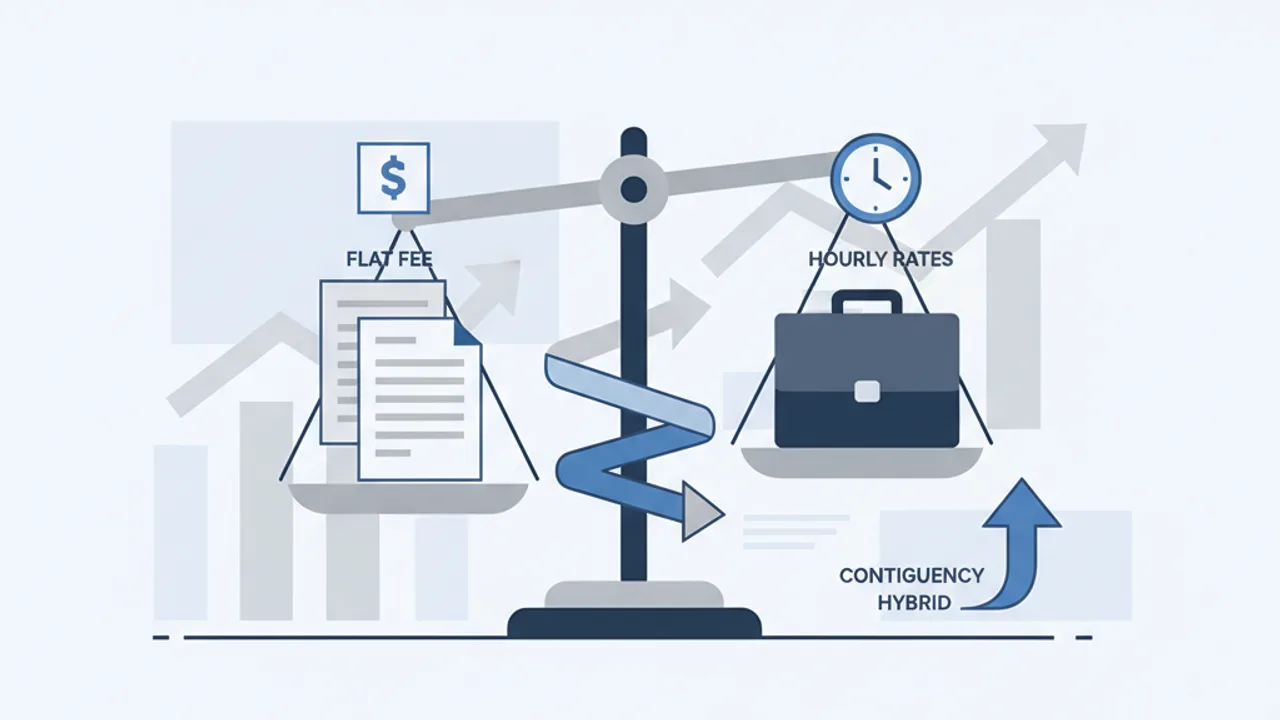
Key Takeaways
- Flat fees are standard for discrete work: contract review $500 to $2,000, demand letters $500 to $1,500, motions to vacate a COJ $3,000 to $8,000.
- Hourly is standard for litigation: rates in 2026 sit in the $300 to $700 range, with New York and California clustering toward the top.
- Retainers typically run $3,000 to $10,000 for defense work, with hourly fees drawn down against the retainer and replenished monthly.
- Contingency is uncommon in MCA defense because there is rarely a pot of money to share, but hybrid arrangements exist in pure settlement work.
- Three factors drive cost up or down most: case complexity, jurisdiction, and counterparty sophistication. Stacked multi-funder cases with aggressive plaintiffs cost more than single-funder matters.
- Always ask for a written engagement letter with hourly rates, scope, retainer amount, refund terms, and what triggers a scope change.
MCA lawyer cost depends on the engagement type, the jurisdiction, and how far the case goes. For a straightforward contract review before signing, expect a flat fee between $500 and $2,000. For defense against a filed lawsuit, expect hourly billing at $300 to $700 per hour, an initial retainer in the $3,000 to $10,000 range, and total cost through settlement in the $10,000 to $40,000 band for a contested case with meaningful discovery. Contingency and hybrid arrangements exist but are less common than pure flat-fee or hourly work. The table below is the 2026 snapshot, and the sections that follow walk through each fee structure with the scenarios where it applies.
| Engagement | Typical Fee Structure | Typical Range |
|---|---|---|
| Pre-signing contract review | Flat fee | $500 to $2,000 |
| Demand letter or settlement outreach | Flat fee | $500 to $1,500 |
| Motion to vacate confession of judgment | Flat fee | $3,000 to $8,000 |
| Full lawsuit defense | Hourly against retainer | $10,000 to $40,000 total |
| Settlement-only (post-default, pre-suit) | Hybrid or contingency | 20 to 40 percent of savings |
Flat Fee Engagements
Flat fees work when the scope is clearly defined and the work is predictable. Most of the common pre-litigation engagements fall into this bucket.
Contract review. A pre-signing review of an MCA agreement is typically two to four hours of attorney time. The attorney reads the contract, flags problematic clauses, and provides a written or verbal summary of the economic and legal risks. At $500 to $2,000 flat, it is the cheapest work a merchant can buy, and for any advance over $50,000 it is usually a good investment. The sibling article on MCA agreement lawyer contract review covers what a review actually flags.
Demand letters. A written demand from counsel to the funder, often used as an opening move in pre-suit negotiation. The letter asserts legal positions (usually some combination of reconciliation rights, recharacterization arguments, and specific contract provisions) and offers terms. Flat fees run $500 to $1,500. These are most useful when the merchant is pre-default and has a specific ask.
Document preparation. Stand-alone document drafting for settlement agreements, UCC-3 termination statements, or corporate resolutions related to a settlement. Flat fees typically $500 to $2,500 depending on complexity.
Motion to vacate a confession of judgment. If a COJ has been entered and the fact pattern supports a motion to vacate (procedural defects, substantive unconscionability, or in the case of New York post-2019 contracts, the statutory ban on out-of-state COJs), the motion itself is typically flat-fee. Ranges run $3,000 to $8,000 depending on complexity and whether oral argument is anticipated. New York's 2019 reform to CPLR 3218 eliminated the COJ option against out-of-state debtors but did not automatically vacate pre-existing judgments, so motion work continues on older filings.
Combined flat packages. Some firms bundle pre-litigation work into a single flat fee: contract review plus demand letter plus follow-up correspondence for a fixed price, typically $2,500 to $5,000. This can be cost-effective if the scope holds but can run over budget if the case escalates.
Hourly Litigation
Once a lawsuit is filed, the engagement almost always shifts to hourly billing. The work becomes unpredictable (discovery scope, motion practice, opposing counsel's tactics) and flat fees stop making sense for either side.
Hourly rates. 2026 rates for MCA defense work range $300 to $700 per hour. Senior partners at New York or California firms cluster toward the top. Mid-level attorneys at regional firms are often $350 to $500. Solo practitioners with deep MCA experience can be anywhere in the range depending on market and caseload.
Retainer structure. Most defense engagements start with a retainer of $3,000 to $10,000. The retainer is held in the firm's IOLTA trust account and billed against as work is performed. The engagement letter specifies a threshold (often 25 percent of the retainer) at which a replenishment request goes out. Some firms require monthly replenishment; others are more flexible.
Typical total cost. A contested MCA lawsuit defended through settlement typically runs $10,000 to $40,000 in total legal fees. The distribution is roughly: $3,000 to $8,000 for initial answer and motion practice, $5,000 to $20,000 for discovery (document review, depositions), and $2,000 to $10,000 for settlement negotiation or summary judgment work. Cases that go to trial push higher, often $60,000 to $150,000 in combined fees, which is why both sides usually settle.
What to ask for in the engagement letter. Hourly rate, retainer amount, what counts as billable (travel, phone calls, research), how disbursements are handled, whether junior associates will be used and at what rates, and what triggers a scope change or additional retainer. Reputable firms put all of this in writing. If a firm resists putting it in writing, walk.
Contingency and Hybrid Arrangements
Pure contingency is uncommon in MCA defense because the "recovery" in a typical defense case is not a pot of money. The win is usually a dismissed claim, a reduced judgment, or a discounted settlement, which does not produce cash that an attorney can take a percentage of.
Contingency does appear in specific MCA scenarios. The clearest is plaintiff-side work where the merchant has an affirmative claim (for example, a claim that the funder violated a state disclosure law or made a fraudulent representation). If the merchant is suing the funder and seeking damages, contingency at 25 to 40 percent of recovery is a standard structure.
Hybrid arrangements are more common than pure contingency. A typical hybrid is a reduced hourly rate (often 50 to 70 percent of the attorney's standard rate) plus a contingency share of any savings achieved off the face balance of the MCA debt. For example: $200 per hour plus 20 percent of savings, measured as the difference between the face balance and the final settlement. This structure aligns incentives but is harder to budget in advance.
Settlement-only engagements (where the merchant is in default but no lawsuit has been filed) sometimes use a contingency-like structure: the attorney takes 20 to 40 percent of savings achieved off face balance. This is less common than flat or hourly arrangements but exists. For merchants comparing this to what a debt relief firm would charge, the MCA debt relief vs DIY settlement comparison has the break-even math.
What Drives Cost Up or Down
Three factors account for most of the variance in total MCA legal fees.
Case complexity. A single-funder lawsuit on clean facts (reconciliation requested and denied, documented hardship, single MCA) is cheaper to defend than a multi-funder stack with overlapping UCC filings and disputed priority. Discovery scope, number of depositions, and motion volume all scale with complexity.
Jurisdiction. New York supreme court, commercial division, sees the most MCA cases in the country because so many funders are headquartered there or include New York choice-of-law clauses in their contracts. The New York Unified Court System publishes opinions that shape the recharacterization doctrine. New York attorneys' hourly rates reflect both the specialty knowledge and the local market. Cases in other jurisdictions can be cheaper on an hourly basis but may require coordinating with New York counsel on the underlying legal questions.
Counterparty sophistication. Some funders litigate aggressively with in-house counsel or experienced outside firms. Others are more willing to settle early. The attorney can often tell after the first exchange of correspondence which counterparty they are dealing with, and the cost implications of each are meaningful.
Other factors matter at the margin: the volume of documents to review (an MCA with three years of ACH pulls and multiple reconciliation requests has more documents than one with six months), whether a confession of judgment was entered (adds motion practice), and whether multiple guarantors are named (multiplies communications).
For tracking cost against case progress, merchants should keep a monthly view of fees billed, retainer balance, and what work was completed. Reputable firms send detailed monthly invoices; scrutinize them and ask questions when line items are unclear.
How to Negotiate a Retainer
Attorney fees are not as negotiable as most merchants assume, but there are specific levers that experienced clients use.
Scope cap. Ask for a monthly fee cap or a total cap on the engagement, with a clear process for approving work above the cap. Attorneys are wary of hard caps because the work is unpredictable, but soft caps with approval gates are common.
Itemized billing. Insist on time entries at six-minute increments (0.1 hour) with a short description of each task. This is the industry standard and any firm that pushes back is a red flag. Itemized billing makes it possible to question specific line items and identifies work that is redundant or outside scope.
Payment plans. For flat-fee work, some firms will accept installment payments (typically half up front, half on completion). For retainer work, the retainer must typically be paid in full before work starts, but replenishment schedules are negotiable.
Junior associate staffing. Most defense work does not require a senior partner on every task. Asking which tasks will be handled by associates at lower rates (and confirming it in the engagement letter) can reduce total cost by 20 to 40 percent without sacrificing quality.
Scope clarity. The most common dispute between client and attorney is over whether a piece of work was within scope or additional. Invest time up front in defining scope tightly. For contract review, that means "one MCA agreement, written summary, one follow-up call." For defense, it means the specific stages (answer, discovery, motion practice) and what happens if the case goes to trial.
For merchants weighing whether to hire an attorney at all versus handling the situation with a debt relief firm or DIY negotiation, the MCA attorney complete guide covers the decision framework. For merchants comparing attorney-led settlement to debt relief company settlement, the MCA debt settlement lawyer vs debt relief company article walks through when each path wins.
FAQ
Sources
- New York CPLR 3218 confession of judgment— New York State Senate
- New York Unified Court System— NY Courts public portal
- American Bar Association on attorney fee agreements— ABA Legal Fee Resources
- Federal Reserve Small Business Credit Survey— Federal Reserve Board
- CFPB Small Business Lending data— Consumer Financial Protection Bureau
Your next step
Lawsuits have deadlines. If you've been served, act in days not weeks. Here are the three paths, ordered by urgency for your situation.
- Talk to an MCA attorneyIf you've been served with a lawsuit or COJ, this is the first call. See what an MCA attorney does and what it costs.
- MCA debt relief companyIf no lawsuit has been filed yet, a debt relief company can often settle before litigation. Disclosure: /how-we-make-money.
- DIY negotiationWorks best before default. Full playbook here.