MCA Lawsuit Defense Strategies: What Actually Works (2026)
Affirmative defenses and procedural strategies that actually work in MCA lawsuits. Recharacterization, usury, unconscionability, UCC violations, venue challenges.
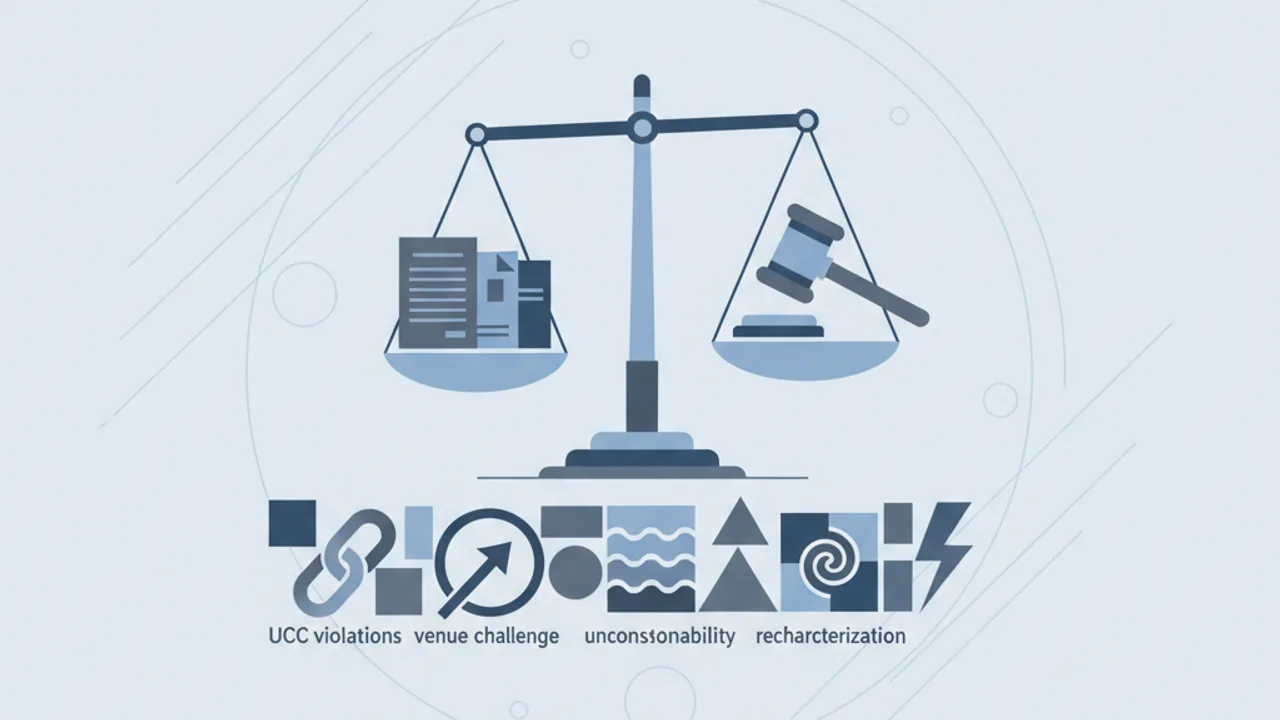
Key Takeaways
- Recharacterization is the anchor defense: if the court finds the MCA was actually a loan, every other contractual protection the funder built in falls away and usury law applies.
- Usury only works after recharacterization. New York civil usury caps interest at 16% per year; criminal usury under Penal Law 190.40 kicks in at 25%. Both require first proving the deal was a loan, not a purchase of receivables.
- Unconscionability can void a contract when the signing process was coercive and the terms were one-sided to a degree no reasonable person would have agreed to. Both elements must be present.
- Failure to reconcile is the most overlooked defense. Most MCA contracts contain a reconciliation provision. When a funder refuses or ignores reconciliation requests, it breaches its own agreement before the merchant owes a dime more.
- Venue challenges matter for out-of-state merchants. New York's 2019 confession-of-judgment ban and federal forum non conveniens doctrine give merchants in Texas, Florida, California, and other states real procedural tools to force a case closer to home.
- Every defense must be pled in the answer or it is waived. Blanket defenses not tied to the facts of your case are risky; a specific, well-pled defense record is what wins summary judgment motions and forces settlement.
Most merchants served with an MCA lawsuit assume the contract controls everything. It does not. MCA contracts are drafted by funders, reviewed by funder counsel, and designed to foreclose every defense you might raise. But courts are not required to enforce contracts that are actually disguised loans, that contain provisions so one-sided they shock the conscience, or that were breached by the funder before the merchant ever defaulted. This article covers the five defenses that consistently produce real results in contested MCA litigation, what each one requires, where each one fails, and how to build the factual record that makes them work. For the broader procedural picture of what happens after you are served, see the MCA lawsuit being-sued playbook. For help selecting a defense attorney, see the MCA defense attorney guide.
Recharacterization Defense: Turning a Purchase Into a Loan
Recharacterization is the foundational MCA defense. The argument is simple: what the funder calls a "purchase of future receivables" is, in substance, a loan. If the court agrees, usury law applies and the transaction may be void or voidable. If the court disagrees, the contract language governs and the funder almost always wins.
New York appellate courts, including in cases like Champion Auto Sales v. Pearl Beta Funding and Davis v. Richmond Capital Group, have developed a three-factor test to decide which side of the line a deal falls on.
The first factor is whether the obligation is absolute or contingent. A true purchase of receivables means the funder absorbs the risk that the receivables never come in. If the business closes, floods, or fails, the funder gets nothing. A loan, by contrast, must be repaid regardless of circumstances. Courts look at the agreement language, the guaranty structure, and the reconciliation mechanics. If the merchant or guarantor is personally obligated to repay a fixed sum no matter what happens to the business, that looks like a loan. Funders try to draft around this with "no fixed repayment date" boilerplate, but courts examine the economic reality of the deal, not just the labels.
The second factor is whether the agreement contains a meaningful reconciliation provision. A genuine purchase of receivables fluctuates with the business. Slower revenue periods mean lower daily pulls; higher revenue periods mean larger pulls. Reconciliation is the contractual mechanism that makes that adjustment happen. If the contract includes a reconciliation provision but the funder systematically refuses to honor it, that cuts toward recharacterization. If the contract lacks any reconciliation provision at all, or if the provision is so procedurally burdensome that no merchant can invoke it in practice, courts treat that as evidence the parties understood the daily pull was fixed regardless of actual receivables performance.
The third factor is the term structure. True receivable purchases do not have a fixed maturity date. The deal ends when the purchased amount is collected, and if the business fails, the funder is simply out. MCA contracts that contain event-of-default provisions tied to specific dates, minimum payment clauses, or fixed repayment windows look more like term loans. Courts have been skeptical of deals that carry a "fixed term to maturity" clause alongside a "purchase of receivables" label.
Building the recharacterization record starts before you file anything. Pull the MCA agreement and annotate every provision that touches repayment: the daily payment amount, the reconciliation procedure, the default events, and the personal guaranty. Compare the labeled daily ACH pulls to actual bank deposits during the advance period. If pulls were constant regardless of deposit volume, you have a factual foundation for the reconciliation and recharacterization arguments.
Usury Defense: What the Cap Actually Means
Usury is the most powerful weapon in the MCA defense toolkit, but it is also the one most often raised prematurely and incorrectly. The rule is straightforward: usury only becomes available as a defense after the court agrees the deal should be recharacterized as a loan. If the court finds the transaction was a true purchase of receivables, no usury defense exists. The funder can collect any amount it contracted for.
Assuming recharacterization succeeds, New York provides two tiers of usury protection. Civil usury under New York General Obligations Law 5-501 caps the interest rate on a loan to a corporation at 16% per year. If the annualized rate on the MCA advance exceeds 16%, the excess interest is voidable. Criminal usury under New York Penal Law 190.40 sets the threshold at 25% per year. A lender that charges more than 25% on a business loan commits a class E felony, and the contract itself is void and unenforceable, not just the excess interest portion.
Most MCA deals, when recharacterized and the effective annual rate is calculated from the factor rate and term, carry rates well above 25%. A 1.40 factor rate on a six-month advance annualizes to roughly 80% APR. A 1.50 factor rate on a three-month advance approaches 200% APR. These numbers are not hypotheticals; they are the arithmetic of typical MCA structures.
Corporations in New York cannot raise civil usury as a defense in most circumstances, which is why criminal usury at the 25% threshold is the operative tool in the vast majority of contested MCA cases. If your business entity is an LLC or corporation rather than a natural person, the criminal usury argument is the one your attorney should develop in detail.
A critical strategic point: courts have been inconsistent on how to calculate the effective interest rate for recharacterized MCA deals. Factor rate alone is not the full picture because reconciliation provisions, origination fees, and the actual collection period all affect the calculation. An expert witness who can present an annualized rate calculation based on actual payment history is a significant asset in contested cases.
Unconscionability Defense: When the Contract Itself Is Unfair
Unconscionability is a contract law doctrine that allows courts to refuse enforcement of agreements that were fundamentally unfair at the moment of signing. In New York, courts require both procedural unconscionability (something was wrong with the process of forming the contract) and substantive unconscionability (the terms themselves are oppressively one-sided). Neither element alone is sufficient.
Procedural unconscionability in MCA transactions typically involves the circumstances of the application and signing. Small business owners routinely describe signing multi-page contracts within hours of applying, with brokers applying pressure and withholding time to review. When the merchant had no meaningful choice and no realistic opportunity to negotiate, courts consider whether the agreement process was coercive. Unequal bargaining power alone is not enough; there must be evidence the merchant had no realistic alternative or was misled about key terms. Funding agreements that were presented in a language the merchant does not fluently read, or that obscured the total repayment obligation in dense fee schedules, have fared poorly when challenged on procedural grounds.
Substantive unconscionability focuses on the terms. Courts look at the total cost of credit relative to what was advanced, the one-sidedness of default provisions, confession-of-judgment clauses in contracts with out-of-state merchants, and the elimination of all merchant protections in the agreement. A contract that allows the funder to declare default for any business slowdown while denying the merchant any reconciliation right, any cure period, and any forum outside the funder's home jurisdiction is a candidate for substantive scrutiny.
The practical challenge with unconscionability is that courts are reluctant to void commercial contracts between businesses. The doctrine is used most successfully as a negotiating tool or as one of several defenses raised together, rather than as a standalone theory on which the merchant stakes the whole case. When combined with evidence of a high effective rate post-recharacterization, unconscionability arguments have contributed to favorable settlements even in cases where they were unlikely to produce an outright dismissal.
Failure to Reconcile Defense: The Breach Built Into Every Contract
The reconciliation defense is the most underused defense in MCA litigation, and it is the one most directly created by the funder's own contract language. Nearly every modern MCA agreement includes a reconciliation provision that requires the funder to adjust daily payment amounts to reflect the merchant's actual revenue performance. The typical provision says something like: "Merchant may request a reconciliation of payments to reflect actual receivables volume; Funder shall conduct such reconciliation within a commercially reasonable time."
When a merchant sends a written reconciliation request and the funder ignores it, delays indefinitely, or refuses on pretextual grounds, the funder is in breach of a material term of its own agreement. That breach has two consequences. First, it is a defense to the funder's breach-of-contract claim: a party that breaches a contract cannot hold the other side liable for a subsequent breach arising from that same agreement. Second, it supports recharacterization: a funder that refuses reconciliation is behaving consistently with a fixed-loan creditor, not a purchaser of contingent receivables.
Building this defense requires a paper trail. Reconciliation requests must be in writing, dated, and specific about the time period and the bank statements being submitted. Send requests by email with read receipts and by certified mail to the address listed in the contract. Keep every response, including form-letter denials and silence. If the funder's standard practice is to reject reconciliation requests routinely, that pattern across multiple merchants can sometimes be established through discovery.
Courts have found for merchants on reconciliation grounds in cases where the merchant submitted multiple documented requests and the funder failed to respond within any reasonable timeframe. The key phrase in most contracts is "commercially reasonable time." Sixty to ninety days of non-response to a written request with supporting bank statements has been held unreasonable in several merchant-favorable decisions.
If you sent reconciliation requests that were ignored, do not include that information in an initial call to funder collections. Save it for your answer and for discovery. It is far more valuable as a pleaded defense supported by documented evidence than as a bargaining chip in an informal negotiation before litigation begins.
Venue and Forum Selection Challenges: Fighting Where the Case Lives
Procedural defenses about where a case should be litigated are among the most time-efficient and cost-effective tools available to MCA defendants. Many merchants in Florida, Texas, California, and other states are sued in New York state court or federal court in New York because the MCA contract contains a forum selection clause pointing to New York. Challenging that clause or the court's jurisdiction can shift enormous leverage, even before the substantive defenses are briefed.
The 2019 New York ban on confessions of judgment against out-of-state defendants is the most important procedural development in recent MCA history. Under New York CPLR Article 32, specifically amendments enacted via S6395, New York no longer accepts confessions of judgment filed on behalf of out-of-state defendants. If a funder obtained a confession of judgment against a merchant outside New York, that judgment is void and unenforceable. The funder must refile as a standard civil action, serve process properly, and allow the merchant a full opportunity to defend. This resets the clock and reopens every substantive defense described above. The NY confession of judgment ban article explains the procedural steps in detail.
For cases filed as regular lawsuits in New York, merchants outside the state can challenge personal jurisdiction if they have no meaningful contacts with New York beyond signing an MCA contract. Long-arm jurisdiction under New York CPLR 302 requires either that the defendant transacted business in New York or that the contract was to be performed there. Signing a contract sent by a New York funder is generally not enough on its own; courts look at whether the merchant actually conducted business in New York.
Forum non conveniens is an additional tool in federal court. Under 28 U.S.C. 1404(a), a defendant may move to transfer a case to a more convenient forum if the balance of private and public interest factors favors transfer. For a Texas merchant sued in the Southern District of New York, the relevant witnesses (employees, the merchant's accountant, the merchant's bank), the documents (bank records, business records), and the practical inconvenience of litigating cross-country all support transfer.
Even if the venue challenge ultimately fails, it forces the funder to litigate the motion, spend counsel time responding, and potentially delay enforcement. For a merchant in early-stage settlement discussions, that delay and cost-shifting creates real negotiating room. Consult the MCA lawsuit attorney guide and the full MCA attorney complete guide for how to select counsel experienced in both the procedural and substantive dimensions of these cases.
Sources
- New York CPLR Article 32 (Accelerated Judgment)— nycourts.gov
- NY S6395 -- Confession of Judgment Reform— nysenate.gov
- Federal Rules of Civil Procedure Rule 12(b)— law.cornell.edu
- CFPB -- Small Business Lending Data and Market Practices— consumerfinance.gov
Your next step
Lawsuits have deadlines. If you've been served, act in days not weeks. Here are the three paths, ordered by urgency for your situation.
- Talk to an MCA attorneyIf you've been served with a lawsuit or COJ, this is the first call. See what an MCA attorney does and what it costs.
- MCA debt relief companyIf no lawsuit has been filed yet, a debt relief company can often settle before litigation. Disclosure: /how-we-make-money.
- DIY negotiationWorks best before default. Full playbook here.