MCA Factor Rates Explained: Why 1.35 Equals 70%+ APR (2026)
A 1.35 factor rate is not 35%. On a 12-month MCA it works out to 70%+ effective APR. See how factor rates work, the APR formula, and free calculator inside.
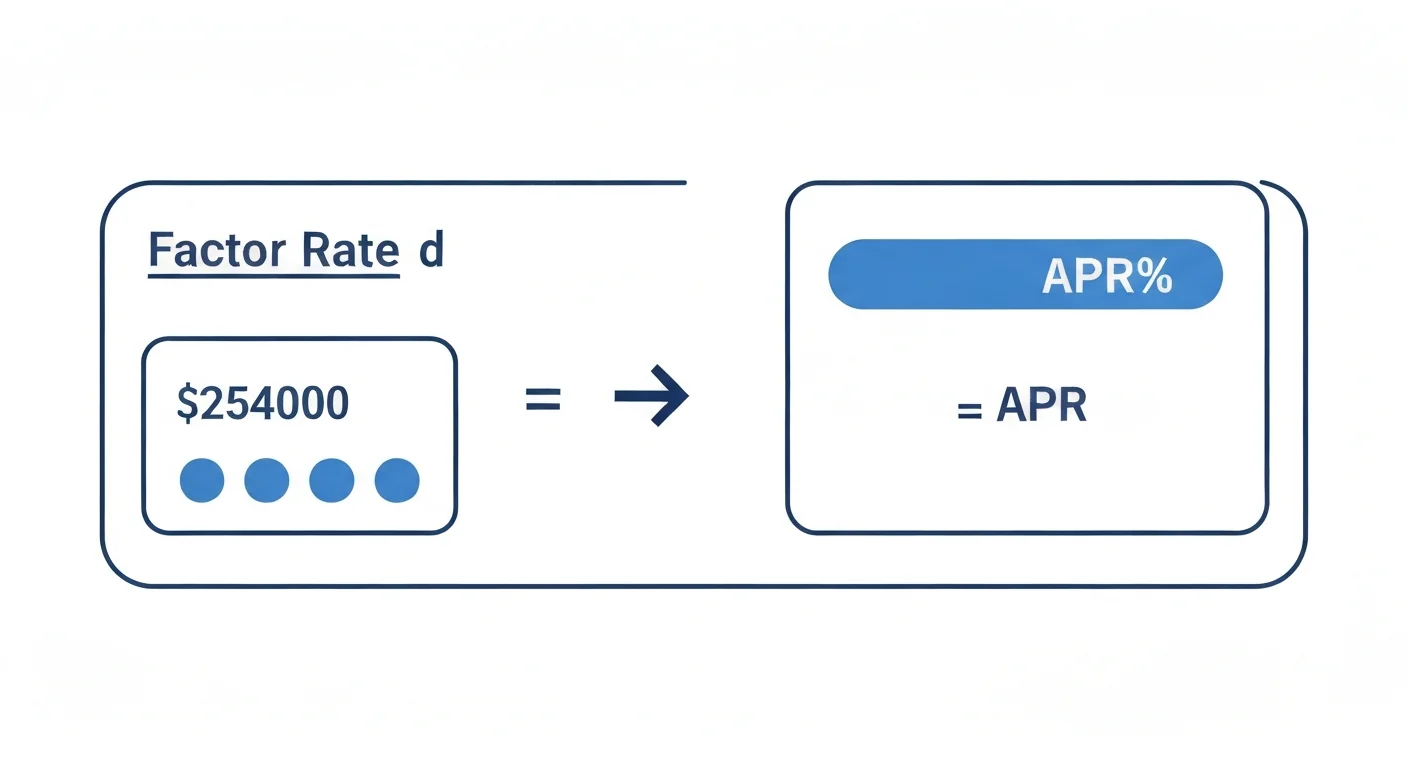
Key Takeaways
- Factor rate is not interest rate. A factor rate of 1.35 is NOT 35% APR. On a 6-month MCA, 1.35 typically equals 70-90% APR.
- Quick formula: Advance amount × factor rate = total repayment. Example: $50,000 × 1.35 = $67,500 total.
- APR conversion shortcut: (Factor rate - 1) × (12 / repayment months) × 2 = approximate APR. So 1.35 over 6 months ≈ 140% raw, roughly 70% APR in practice.
- Typical factor rate range: 1.10 to 1.50. Lower factor rates require stronger credit, revenue, and time-in-business profiles.
- Factor rate does NOT reduce with early payoff on most MCAs, unlike interest-based loans. Some providers offer prepayment discounts.
- Free APR converter: factor rate to APR calculator does the math for you.
If you have been researching merchant cash advances, you have almost certainly encountered the term "factor rate." Unlike traditional loans that use annual percentage rates (APR), MCAs price their products using a decimal multiplier that determines your total repayment amount upfront. Understanding how factor rates work is essential to evaluating whether an MCA is the right funding option for your business. and to avoiding overpaying.
In this guide, we break down what factor rates are, how they compare to interest rates, how to calculate your total cost, and what influences the rate you receive.
What is a Factor Rate?
A factor rate is a decimal number, typically ranging from 1.1 to 1.5, that represents the total cost of a merchant cash advance. Unlike an interest rate, which expresses a recurring cost over time, a factor rate is a simple multiplier applied to the amount you receive. The result tells you exactly how much you will repay in total.
For example, if you receive $50,000 with a factor rate of 1.30, your total repayment obligation is $65,000. That means $15,000 is the cost of the advance. This amount is fixed from day one. it does not compound or change based on how long repayment takes.
How Factor Rates Are Expressed
Factor rates are always expressed as a decimal greater than 1.0. Here is how to interpret common factor rates:
- 1.10. You repay $1.10 for every $1.00 advanced (10% cost)
- 1.20. You repay $1.20 for every $1.00 advanced (20% cost)
- 1.30. You repay $1.30 for every $1.00 advanced (30% cost)
- 1.40. You repay $1.40 for every $1.00 advanced (40% cost)
- 1.50. You repay $1.50 for every $1.00 advanced (50% cost)
The simplicity of this model is part of what makes MCAs appealing to providers and, in some cases, to borrowers. There is no amortization schedule to parse, no compounding interest to track, and no fluctuating monthly payments based on outstanding principal. However, that simplicity can also obscure the true annual cost of the funding, which is why it is important to understand how factor rates compare to traditional interest rates.
Why MCAs Use Factor Rates Instead of Interest
Merchant cash advances are technically not loans. They are structured as purchases of future receivables. Because of this legal distinction, MCA providers are not required to disclose an APR or follow the same lending regulations that apply to banks and credit unions. Factor rates emerged as the standard pricing mechanism for this product category because they align with the fixed-cost, revenue-based repayment model that defines MCAs.
According to the Federal Reserve, alternative financing products like MCAs have grown significantly as small businesses seek faster access to capital, even as regulatory frameworks continue to evolve.
Factor Rate vs Interest Rate
One of the most common points of confusion for business owners is the difference between a factor rate and a traditional interest rate. While both represent the cost of borrowing, they work in fundamentally different ways.
An interest rate, expressed as an APR, represents the annual cost of borrowing and compounds over time. If you pay off a traditional loan early, you pay less interest because the principal decreases. A factor rate, on the other hand, is a flat multiplier. The total cost is locked in from the start, regardless of how quickly you repay.
| Feature | Factor Rate | Interest Rate |
|---|---|---|
| Format | Decimal multiplier (e.g., 1.35) | Percentage (e.g., 12% APR) |
| Compounds? | No. fixed total cost | Yes. cost increases over time |
| Early payoff benefit? | Usually none. you pay the full amount | Yes. less interest accrues |
| Transparency | Can obscure true annual cost | Standardized (APR) |
| Used by | MCA providers | Banks and traditional lenders |
This distinction matters most when you consider the effective annual cost. A factor rate of 1.30 on a six-month advance does not mean you are paying 30% per year. Because you are repaying 30% of the advance amount in just six months, the effective APR equivalent can be significantly higher. often 60% or more.
The U.S. Small Business Administration encourages business owners to compare funding options using a standardized cost metric whenever possible. While MCAs do not always provide an APR equivalent, you can calculate one yourself (more on that below).
When Factor Rates Make Sense
Factor rates are not inherently good or bad. They make the most sense in situations where:
- You need funding quickly and cannot wait for traditional loan approval
- Your revenue is strong but your credit history limits traditional options
- You have a specific, short-term use for the funds with a clear return on investment
- Predictability of total cost matters more to you than minimizing absolute cost
However, if you have the option to qualify for a traditional business loan or line of credit, the interest rate structure will almost always result in a lower total cost, especially for longer repayment periods.
How to Calculate MCA Cost Using Factor Rates
Calculating the cost of an MCA using a factor rate is straightforward. Here is the step-by-step process.
Quick Formula
Total Repayment = Funding Amount × Factor Rate. For example: $40,000 × 1.25 = $50,000 total repayment ($10,000 in fees).
Step-by-Step Calculation
Step 1: Identify the funding amount. This is the amount of cash you will receive. For this example, let's say you are offered $40,000.
Step 2: Identify the factor rate. Your MCA provider quotes you a factor rate of 1.25.
Step 3: Multiply the funding amount by the factor rate.
$40,000 x 1.25 = $50,000
Your total repayment is $50,000. The cost of the advance (the fee) is $10,000.
Step 4: Determine the daily or weekly payment. If the MCA provider collects payments over 6 months (approximately 126 business days), your estimated daily payment would be:
$50,000 / 126 = approximately $397 per business day
Estimating the Effective APR
To compare an MCA to a traditional loan, you can estimate the effective APR using this approach:
- Calculate the fee: $50,000 - $40,000 = $10,000
- Divide by the funding amount: $10,000 / $40,000 = 0.25 (25%)
- Annualize it: If repayment takes 6 months, multiply by 2 to estimate the annual equivalent: 25% x 2 = 50% estimated APR
This is a simplified estimate. The actual effective APR can vary depending on payment frequency and the specific holdback structure. But it gives you a useful benchmark for comparison.
More Real-World Examples
Here are a few additional scenarios to illustrate how different factor rates affect total cost:
- $25,000 at 1.15 factor rate: Total repayment = $28,750. Cost = $3,750.
- $75,000 at 1.35 factor rate: Total repayment = $101,250. Cost = $26,250.
- $100,000 at 1.45 factor rate: Total repayment = $145,000. Cost = $45,000.
As you can see, even small differences in the factor rate can translate to thousands of dollars in additional cost, especially at higher funding amounts. This is why negotiating the best possible factor rate is one of the most impactful steps you can take when pursuing an MCA.
Typical Factor Rate Ranges
Factor rates vary widely depending on the provider, your business profile, and market conditions. However, most MCA factor rates fall within the following ranges.
What Is Considered a Good Factor Rate?
- 1.10 to 1.20: Excellent. These rates are typically reserved for well-established businesses with strong revenue and good credit. If you are offered a rate in this range, it suggests the provider sees your business as low risk.
- 1.20 to 1.30: Average. This is the most common range for businesses with moderate credit and steady revenue. Most first-time MCA borrowers land in this bracket.
- 1.30 to 1.40: Above average cost. You may see rates in this range if your credit score is lower, your time in business is limited, or your industry is considered higher risk.
- 1.40 to 1.50 (or higher): Expensive. Rates at this level significantly increase the total cost of funding. Proceed with caution and carefully evaluate whether the advance will generate enough return to justify the expense.
Keep in mind that factor rates below 1.10 are rare and may indicate a promotional offer or a very short repayment term. Rates above 1.50 exist but are typically offered by less reputable providers or to businesses in financial distress.
What Affects Your Factor Rate
MCA providers evaluate several factors when determining your rate. Understanding these can help you position your business for better terms.
Credit Score
While MCAs are more accessible than traditional loans, your personal and business credit scores still matter. A higher credit score signals lower risk, which typically results in a lower factor rate. Most MCA providers look for a minimum credit score of around 500, but the best rates go to applicants with scores above 650.
Time in Business
Providers prefer businesses with a track record. Companies that have been operating for at least one to two years tend to receive better factor rates than startups. Longevity demonstrates stability and reduces the provider's perceived risk.
Monthly Revenue
Because MCAs are repaid through a percentage of daily or weekly revenue, your monthly revenue is one of the most important factors. Higher revenue means faster repayment and lower risk for the provider, which translates to better rates. Most providers require a minimum of $8,000 to $15,000 in monthly revenue.
Industry Type
Some industries are considered higher risk than others. Businesses in sectors with volatile revenue. such as seasonal tourism, restaurants during off-peak periods, or construction. may face higher factor rates. Conversely, businesses with predictable, recurring revenue streams (like SaaS companies or medical practices) often qualify for more favorable terms.
Existing Advances or Debt
If you already have one or more outstanding MCAs, providers may view you as a higher-risk borrower. Stacking multiple advances increases the likelihood of default, so providers often charge higher factor rates. or decline the application altogether. The Consumer Financial Protection Bureau has noted that multiple advances can create a cycle of debt that is difficult to break.
Bank Statement Health
MCA providers typically review three to six months of bank statements. They look for consistent deposits, a healthy average daily balance, and the absence of frequent overdrafts or negative balances. Strong bank statements can offset a lower credit score in many cases.
Try These Free Tools
- Factor Rate to APR Converter — instantly convert any factor rate to APR
- MCA Cost Calculator — see total cost, daily payment, and effective APR
- MCA Payment Schedule — generate a full daily payment calendar
Frequently Asked Questions
Can I negotiate my MCA factor rate?
Do I save money if I repay my MCA early?
How do I convert a factor rate to an APR?
Is a factor rate of 1.40 too high?
Sources
- Federal Reserve. Small Business Lending. Data and research on small business lending trends, including alternative financing products.
- U.S. Small Business Administration. Funding Programs. Official SBA resource for comparing traditional and alternative business funding options.
- Consumer Financial Protection Bureau. Merchant Cash Advances. CFPB consumer guidance on how merchant cash advances work and their potential risks.