MCA Debt Restructuring: How It Works and When to Choose It (2026)
MCA debt restructuring keeps your relationship with the lender while changing terms. Covers reconciliation, modified holdbacks, extended terms, and payment pauses.
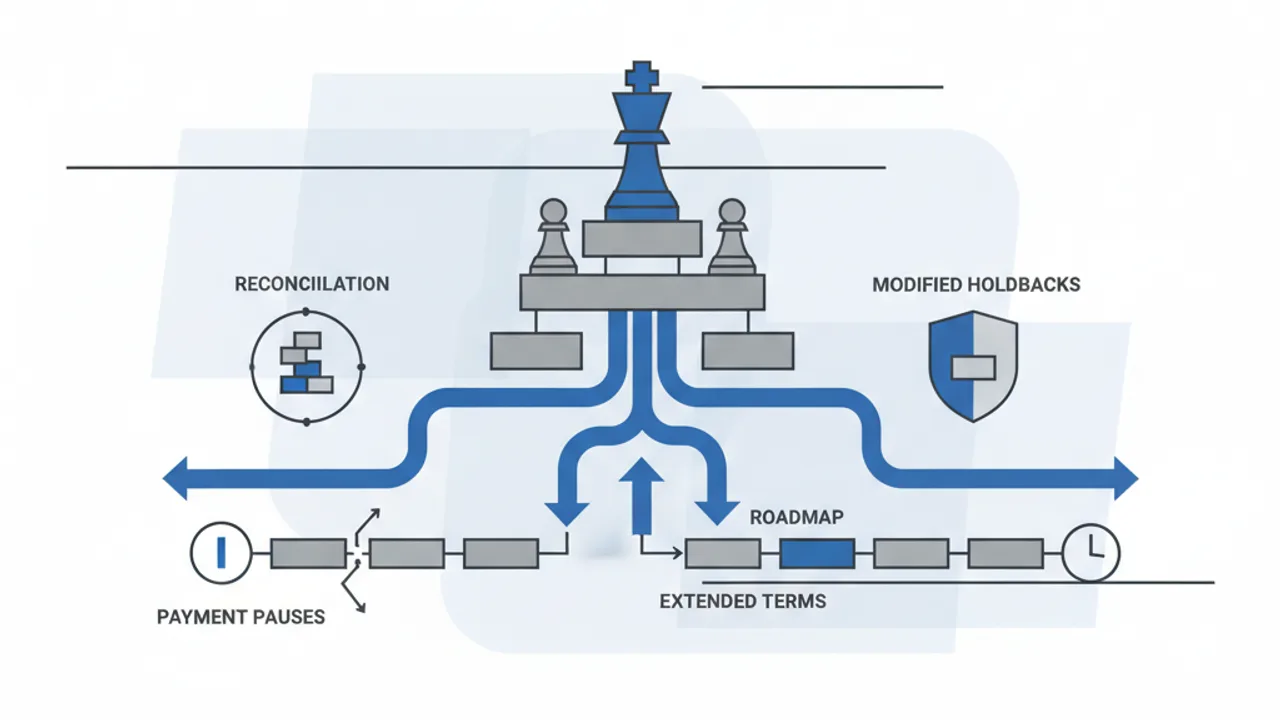
Key Takeaways
- Restructuring is not settlement: you are not reducing the total you owe, you are changing the terms under which you repay it. The relationship with the funder continues.
- Reconciliation requests are the most common form of restructuring -- adjusting the daily or weekly holdback to reflect actual revenue, which is often written into the original MCA agreement as a right.
- Term extensions spread the same total repayment over a longer period, reducing daily payment stress without reducing total owed.
- Payment pauses and forbearance are temporary and must be documented in writing; verbal pauses are not enforceable.
- A full restructure agreement amends the original contract and can combine multiple elements -- lower holdback, extended term, and a pause period.
- Restructuring beats settlement when the business is fundamentally viable and the problem is cash timing rather than total debt load.
MCA debt restructuring is the process of modifying the terms of an existing merchant cash advance agreement so that the business can continue repaying without defaulting, while maintaining the funder relationship. It is distinct from settlement, which involves paying less than the total owed, and from consolidation, which involves replacing existing obligations with new financing. Restructuring is the right choice when your business has a real future, the total amount you owe is manageable, and the issue is the current payment structure rather than the total balance. This guide covers the mechanics of each type of restructure, when each applies, and when to choose restructuring over settlement.
Restructuring vs Settlement: The Key Distinction
The most important thing to understand about MCA debt restructuring is what it does not do: it does not reduce the total amount you owe. If your remaining purchased amount is $120,000, a restructure agreement will still result in you repaying $120,000 (or very close to it). What changes is the pace and structure of that repayment.
Settlement, by contrast, reduces the total obligation. You pay a negotiated lump sum or structured amount that is less than the full remaining balance, and the funder releases the obligation entirely. See the MCA settlement complete guide and MCA debt settlement 2026 update for detailed coverage of that path.
Choose restructuring when:
- The total balance is manageable relative to your business's revenue capacity
- Cash flow is stressed but the underlying business is viable
- You want to maintain the funder relationship (for future access to capital)
- You are not yet in default or are only recently delinquent
- The stress is caused by a temporary event (seasonal downturn, delayed receivable, equipment failure) rather than a permanent reduction in revenue
Choose settlement when:
- The total balance is disproportionate to your business's earning capacity
- You are significantly in default and the funder has begun legal action
- Multiple advances are stacking and you cannot realistically repay all of them even with modified terms
- The business is fundamentally in a different financial position than it was when the advance was originated
Many businesses go through a restructuring attempt before concluding that settlement is the necessary path. Starting with restructuring is not wrong -- it preserves optionality and maintains the funder relationship -- but it should be accompanied by a realistic assessment of whether the total balance is actually serviceable.
Reconciliation Requests: Lowering Your Daily or Weekly Holdback
Most MCA agreements include a reconciliation provision. The standard language says something to the effect that the holdback percentage represents a specified percentage of "future receivables," and that if revenue has declined, the business can request an adjustment so that the daily or weekly payment reflects actual revenue rather than projected revenue.
Reconciliation is often the first and most straightforward restructuring tool. You are not asking the funder to forgive anything -- you are asking them to honor the original formula more accurately.
How to request a reconciliation:
- Locate the reconciliation provision in your advance agreement. It will typically be in the section covering the holdback or remittance amount.
- Gather bank statements for the past 2 to 3 months showing actual daily deposits.
- Calculate what the holdback percentage applied to actual revenue would yield as a daily payment, compared to the current fixed daily payment.
- Submit a written reconciliation request to the funder's servicing department, including the bank statements and your calculation.
Funders are legally obligated to process legitimate reconciliation requests under agreements that include this provision. They may push back or delay, but a properly documented request is hard to refuse if the contract language supports it.
Typical outcomes: A successful reconciliation can reduce daily or weekly payments by 20 to 50 percent, depending on how much revenue has declined since origination. The total amount still owed does not change; the payments are simply stretched over a longer effective period as a result of lower daily amounts.
Term Extensions: More Time, Same Total Repayment
A term extension restructures the remaining balance over a longer repayment period than originally contemplated. Since MCA repayment is tied to holdback percentages rather than a fixed calendar schedule, a term extension is typically implemented by reducing the daily or weekly payment amount while keeping the total purchased amount constant.
From the business owner's perspective, a term extension provides breathing room. From the funder's perspective, it delays full repayment but avoids the cost and uncertainty of collection. Term extensions are more likely to be approved when:
- The business can demonstrate positive cash flow at the reduced payment level
- The remaining balance is above $50,000 (smaller balances are sometimes not worth the administrative effort of modification)
- The business has not yet defaulted or is only 15 to 30 days delinquent
- There is no competing lien from another MCA funder that creates a priority dispute
Mechanics of a term extension agreement: The amendment should state the new daily or weekly payment amount, confirm the unchanged total purchased amount, specify the new estimated completion date, and confirm that all other terms of the original agreement remain in effect. Have legal counsel review before signing if the balance is large.
One caution: term extensions do not reduce the effective cost of the advance. If you originally funded at a 1.35 factor rate, you are still repaying at a 1.35 factor rate -- just more slowly. If your business's problem is total debt load rather than payment timing, a term extension will not fix it.
Payment Pauses and Forbearance
A payment pause, sometimes called forbearance, is an agreement with the funder to temporarily halt or reduce payments for a defined period -- typically 30 to 90 days -- without triggering default consequences. This is used for businesses facing a short-term cash crisis where recovery is anticipated within a clear timeframe.
Common scenarios that support a forbearance request:
- A large receivable that is delayed by 45 to 60 days
- A seasonal revenue trough (e.g., a retail business between November and February)
- An equipment failure or business interruption that temporarily reduced revenue
- A pending refinancing or capital raise that will enable resumption of payments
Critical rule: get it in writing. Verbal forbearance agreements are unenforceable. A funder rep who says "don't worry, we'll put your payments on hold" over the phone is not creating a binding obligation. You need a written forbearance agreement that specifies the pause period, the date on which payments resume, the payment amount at resumption, and confirmation that the pause does not constitute a default or trigger any penalty provisions.
What funders require for forbearance approval: Most will ask for a brief explanation of the hardship, evidence that it is temporary (such as a receivable invoice, a signed lease renewal, or a capital commitment letter), and confirmation that the business is otherwise current on its obligations to the funder. Some funders charge a forbearance fee, which should be modest and disclosed in writing before you agree.
Full Restructure Agreements: Amended Contracts
A full restructure agreement goes beyond a single modification -- it amends the original advance agreement to reflect a new set of terms that the business can realistically service going forward. This is the most comprehensive form of restructuring and is typically used when the business needs multiple simultaneous changes: a lower holdback, an extended term, and possibly a short pause before payments resume.
A full restructure agreement should address:
New payment amount. The revised daily or weekly holdback, expressed either as a fixed dollar amount or a percentage of deposits. If expressed as a percentage, make sure the calculation methodology is clear.
Revised estimated completion date. Based on the new payment amount applied to the remaining balance.
Confirmation of remaining purchased amount. Make sure the document clearly states the current remaining balance as the starting point, so there is no dispute later.
Treatment of prior missed payments. If you missed payments during the negotiation period, the agreement should state how those are handled -- typically they are either waived, added to the back end of the repayment, or required to be paid as a separate catch-up amount.
Default provisions. What happens if you miss payments under the new structure? The default trigger should be no more aggressive than the original agreement. Be wary of amendments that lower the default threshold (for example, to a single missed payment) as a condition of the restructure.
UCC and lien status. A restructure does not require a new UCC filing, but confirm that the existing UCC-1 covers the restructured arrangement and that the funder is not adding new or expanded collateral claims.
When Restructuring Beats Settlement
Restructuring is not always the inferior choice to settlement. There are situations where it is clearly the right path.
Future funding access. Settlement closes the funder relationship and often results in that funder declining to work with you in the future. If you anticipate needing MCA financing again after your business stabilizes, a successful restructure that you complete in good standing preserves that access. This matters in industries where MCA is one of the few available funding mechanisms.
No discount required. Settlement involves a write-down that the funder has to approve. Many funders will not approve significant discounts for businesses that are still generating meaningful revenue. A restructure can be negotiated even when the business is not distressed enough to justify a settlement offer, giving you relief without the awkwardness of asking for a discount you are not clearly entitled to.
Credit and public record considerations. MCA default and settlement, while not directly reported to personal credit bureaus, can appear in commercial credit profiles and business banking relationships. A restructure completed without default is a cleaner outcome for your commercial credit history.
Simpler documentation. A restructure negotiation is typically shorter and less document-intensive than a settlement. No hardship analysis, no loss reserve conversation, no weeks of back-and-forth over percentages. If your situation is straightforward, restructuring can be resolved in a few days.
For a tactical framework on executing a restructure, see the MCA restructuring playbook. For the full context of exit options, see the MCA debt relief 2026 guide and the comparison between DIY and professional approaches.
Sources
- SBA Office of Advocacy -- Small Business Credit Markets Report— U.S. Small Business Administration
- UCC Article 9 -- Secured Transactions— Cornell Legal Information Institute
- CFPB -- Small Business Lending Resources— Consumer Financial Protection Bureau
- FTC -- Commercial Credit and Business Finance Guidance— Federal Trade Commission
Your next step
If you're dealing with MCA debt, these are the three paths that actually work. Start with the cheapest option that fits your situation.
- DIY negotiationFree and the most common starting point. Use our negotiation playbook first.
- MCA debt relief companyPaid service that handles negotiation for you. See our side-by-side comparison. Our disclosure: we work with Coastal Debt Resolve, details on /how-we-make-money.
- MCA attorneyNeeded when lawsuits are filed or contracts are legally defective. See the attorney guide.