How to Respond to an MCA Lawsuit (Step-by-Step 2026)
Answer vs motion to dismiss, drafting affirmative defenses, state deadlines (NY 20/30, FL 20, TX 28, CA 30, federal 21), and filing and service rules.
Key Takeaways
- Deadlines vary by state and method of service. New York allows 20 days for in-person service and 30 days by mail. Florida and federal court give you 20 and 21 days respectively. Missing the deadline hands the funder a default judgment.
- Read the entire complaint before choosing your response path. The causes of action, the amount demanded, and the court chosen by the funder all affect whether an answer or a motion to dismiss is the right first move.
- Plead every affirmative defense at once. In New York CPLR practice and in most state courts, defenses not raised in the initial answer are waived. You cannot add them later without leave of court, which is not guaranteed.
- A motion to dismiss is faster but carries risk. If the motion is denied, some defenses may be treated as abandoned, and you still need to answer. Most MCA defense attorneys lead with a comprehensive answer and reserve motion to dismiss for strong jurisdictional or pleading defects.
- Proof of service on the funder is mandatory. Filing a response with the court is not enough; you must serve opposing counsel or the funder directly and file proof of that service with the court.
- Even a pro se answer with real defenses beats a default. A default judgment requires no trial and allows the funder to go straight to collection. A filed response, even imperfect, preserves your leverage and opens settlement negotiations.
Being served with an MCA complaint is not the end of the road. It is the beginning of a litigation process that the funder actually prefers to settle before trial, provided the merchant responds on time and puts real defenses on record. The critical variable is not the strength of the case at day one; it is whether the merchant meets the response deadline with a document that forces the funder to keep litigating. This guide walks through how to read the complaint, how to choose between an answer and a motion to dismiss, which defenses to plead, what deadlines apply in each major state, and how to file and serve the response correctly. For deeper coverage of the specific defenses available, see the MCA lawsuit defense strategies article. For the full first-30-days picture, see the MCA lawsuit being-sued playbook.
Reading the Complaint: What to Look For Before You Write a Single Word
The complaint is a formal document, but it contains a specific set of facts and claims that determine your entire response strategy. Do not skim it. Read it once for the narrative, then again with a highlighter for each of the following elements.
The first thing to identify is the court. Is this New York Supreme Court, a federal district court, or a court in your home state? The court controls which procedural rules apply, what your deadlines are, and what defenses you can raise procedurally. An MCA case in the Southern District of New York operates under the Federal Rules of Civil Procedure. The same case in New York Supreme Court operates under the CPLR. These are different bodies of procedure with different deadlines, different pleading standards, and different motion practice rules.
The second element is the plaintiff. Is the funder the original party, or has the claim been assigned to a collection entity or litigation funder? Assignment changes who has standing to sue and whether the original contract terms are enforceable by the new plaintiff. If the plaintiff is an assignee you do not recognize, request the assignment agreement in your answer.
The third element is the causes of action. Most MCA complaints allege breach of contract, breach of guaranty, and sometimes conversion or unjust enrichment. Count the causes of action. Each one requires a separate response in the answer: admit, deny, or deny for lack of information. If the complaint alleges fraud or misrepresentation, the pleading standard under FRCP 9(b) or its state equivalent requires specific facts, not just conclusory language. A fraud count that does not specify dates, statements, and who made them is vulnerable to a motion to dismiss.
The fourth element is the amount demanded. Does the funder seek the entire remaining purchased amount, plus fees, interest, and attorney fees? Check the contract to see whether attorney fee clauses are reciprocal or unilateral. Some MCA contracts allow the funder to recover attorney fees but do not extend that right to the merchant. If you prevail on a defense, knowing whether you can recover fees affects your settlement calculus.
The fifth element is service. How were you served? In-person service by a process server, substitute service at your principal place of business, or service by mail triggers different response deadlines. Improper service is itself a defense: if the funder did not follow the service rules for your state, the complaint may be subject to dismissal for lack of proper service. Document exactly how and when you received the papers.
Answer vs. Motion to Dismiss: Choosing the Right First Move
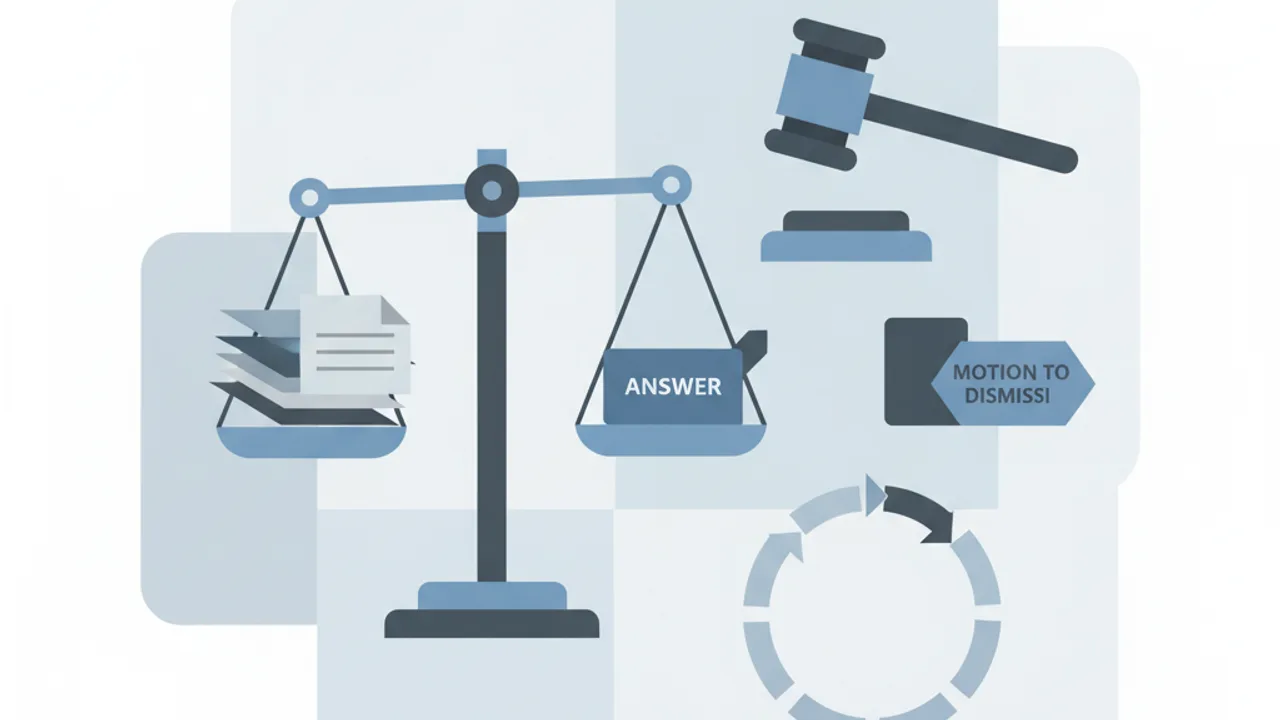
Once you have read the complaint, you face the first strategic choice: file an answer with affirmative defenses, or file a pre-answer motion to dismiss.
A motion to dismiss under New York CPLR 3211 or Federal Rule 12(b) asks the court to throw out the case before you respond to the facts. The available grounds include: failure to state a cause of action (the complaint, even if all facts are true, does not establish a legal claim), lack of personal jurisdiction (the court has no authority over you), improper venue (the case belongs in a different court), improper service of process, statute of limitations, and lack of standing. In federal court, FRCP 12(b) codifies these grounds. New York CPLR 3211 covers the same territory with some procedural differences.
A motion to dismiss is most valuable when you have a clean, documentable threshold defect. If the funder filed in New York state court but you are a California merchant with no New York contacts and the funder used a confession of judgment that the 2019 ban voided, a motion to dismiss on personal jurisdiction and the void judgment is a strong opening move. If the complaint omits required elements of a breach-of-contract claim, a pleading-defect motion can force the funder to refile a better-pled complaint, which costs them time and money.
The risk of a motion to dismiss is waiver. Under CPLR 3211(e), certain defenses, particularly personal jurisdiction and improper service, are waived if not raised in the first motion to dismiss or in the answer. If you file a motion to dismiss that does not include all available defenses, you may lose the ones you left out. Additionally, if the motion is denied, courts typically give you a short window to answer. You will have spent weeks briefing a motion, lost some defenses, and still need to file the answer.
An answer is the safer default path for most MCA defendants. The answer lets you deny the allegations, preserve every affirmative defense, and assert counterclaims if the facts support them, all in a single filing. Many MCA defense attorneys file a comprehensive answer with detailed affirmative defenses and include, as an alternative, a motion to dismiss embedded in the answer for jurisdictional defects. That hybrid approach preserves maximum optionality.
For guidance on the substantive defenses to include in your answer, the MCA defense attorney guide and the MCA attorney complete guide walk through what experienced MCA litigation counsel look for in the contract and payment history.
Drafting Affirmative Defenses: Plead All or Waive
Affirmative defenses are the heart of your answer. An affirmative defense is a legally recognized reason why the funder should not win even if every fact in the complaint is true. New York and most other states treat any affirmative defense not raised in the answer as waived. This means you must identify every applicable defense before you file, not just the ones you are most confident about.
The core MCA affirmative defenses are as follows.
Recharacterization and usury: the transaction was a loan, not a purchase of receivables, and the effective interest rate exceeds the state criminal usury threshold. In New York, this implicates Penal Law 190.40. See LG Funding v. United Senior Properties for the appellate framework.
Failure to reconcile: the contract contains a reconciliation provision; the plaintiff refused or failed to honor it upon written request by the merchant, constituting a material breach by the plaintiff.
Unconscionability: the contract was procedurally unconscionable due to time pressure, unequal bargaining power, and lack of meaningful opportunity to review the terms, and substantively unconscionable due to an effective interest rate and default provisions that no reasonable merchant in a fair transaction would accept.
Breach of the implied covenant of good faith and fair dealing: the funder's conduct in refusing reconciliation, accelerating payment demands, or applying daily pulls that exceeded the contracted percentage of receivables violated the duty of good faith implied in every New York contract.
Failure of consideration: if the funder advanced less than the contracted amount, or withheld an undisclosed origination fee from the advance, partial failure of consideration affects the amount recoverable.
Statute of limitations: New York's statute of limitations for contract claims is six years under CPLR 213. Federal contract claims brought under diversity jurisdiction borrow the forum state's limitations period. If the breach date is more than six years before the complaint was filed, the claim may be time-barred in whole or in part.
Improper service: if the funder did not comply with CPLR 308 or the applicable state service rule, the court lacks personal jurisdiction and the case must be dismissed or service must be re-done.
Forum non conveniens and improper venue: if the forum selection clause is unenforceable or if the balance of private and public interest factors under 28 U.S.C. 1404(a) favors a different forum, the case should be transferred.
Void confession of judgment: if the funder obtained a New York confession of judgment against an out-of-state defendant, the judgment is void under the 2019 amendment. The NY confession of judgment ban article has the statutory analysis.
After listing each defense, add a reservation clause: "Defendant reserves the right to assert additional affirmative defenses as discovery proceeds and additional facts become known." Courts generally allow this language and it protects against hard-to-anticipate defenses surfacing later in the case.
For details on how each of these defenses is built and argued, see the MCA lawsuit defense strategies guide. For help evaluating which defenses fit your specific contract and payment history, the best MCA debt relief companies page covers what to look for when choosing between attorney-led defense and debt-relief alternatives.
Deadlines by State: Do Not Miss This
Response deadlines are jurisdictional. Miss the deadline and the funder can apply for a default judgment without a hearing. Default judgments allow the funder to freeze bank accounts, garnish receivables, and execute on business assets immediately. Reversing a default judgment requires a motion showing excusable neglect and a meritorious defense, a contested process that costs more in attorney time than the original response would have.
Here are the operative deadlines in the states where most MCA litigation occurs.
New York: Under CPLR 3012, a defendant served personally in New York has 20 days to serve an answer or pre-answer motion. Service by registered or certified mail, or by any method other than in-hand delivery, extends the period to 30 days. When in doubt, calendar 20 days from the date you received the papers and treat any additional time as a buffer, not the deadline.
Florida: Florida Rule of Civil Procedure 1.140 gives defendants 20 days to serve a response after service of process. Florida uses in-person service by sheriff or private process server. Mail service for out-of-state defendants may add additional time under Florida's long-arm service rules, but do not assume it.
Texas: Texas Rule of Civil Procedure 99 and related rules give defendants until the Monday next following the expiration of 20 days after service of citation. In practice, most Texas practitioners count 28 days from the date of service as the safe deadline, because the "Monday next following" calculation can be confusing. Calendar 20 days, then confirm the exact due date with a Texas-licensed attorney.
California: California Code of Civil Procedure 412.20 gives defendants 30 days to respond after personal service. Service by publication or substituted service may trigger a different clock. If the funder served you by mail at a California address with an extra five-day notice under CCP 1013, the response period is 35 days.
Federal court: Under FRCP 12(a)(1)(A), a defendant has 21 days after being served with the complaint to file an answer or a 12(b) motion. The United States government has 60 days; individual defendants in federal court have 21. Extensions are available by stipulation of the parties or by court order, and many federal judges expect counsel to agree to modest extensions as a courtesy. But do not rely on courtesy; calendar the 21-day deadline and file before it.
When you calculate any deadline, count from the actual service date, not the date on the complaint or the date you opened the envelope. If you are unsure of the service date, use the earliest possible date. Courts are not sympathetic to missed deadlines based on disputed service calculations.
Filing and Serving the Response: Getting It Done Right
Filing the response incorrectly is almost as damaging as missing the deadline. An answer filed in the wrong court, served on the wrong party, or missing required formatting elements can be rejected or treated as defective.
Start with the court's filing requirements. New York Supreme Court uses the NYSCEF e-filing system for most commercial cases. Federal courts use PACER and CM/ECF. Florida, Texas, and California all have their own e-filing portals. Check the specific court's local rules for file format (PDF, page limits, font size, certificate of service requirements) before you draft the final version of your answer.
Once the document is complete, file it with the court. In most courts, e-filing is now mandatory for attorneys and available to pro se litigants. E-filing generates a timestamped receipt that serves as your proof of timely filing. Print and save that receipt.
After filing, serve the opposing party. Service of the answer on the funder or its counsel must be completed by an allowed method under the applicable rules. In federal court, FRCP 5 governs service of most papers after the initial complaint; email to opposing counsel is sufficient when counsel has already appeared. In New York state court, CPLR 2103 governs. Service can be by hand, by mail, or by electronic means if the parties have agreed to e-service.
Prepare a proof of service. This is a one-page affidavit or certification stating who was served, how they were served, when, and where. In New York it is typically an affidavit of service by a non-party over 18. In federal court it is often a certificate of service signed by counsel. File the proof of service with the court as soon as it is complete.
Pay the filing fee if required. Many states require a filing fee for an answer, particularly if you are asserting a counterclaim. Confirm the fee schedule on the court's website before you appear at the clerk's office or finalize the e-filing.
After the answer is on file, contact the funder's counsel to open settlement discussions if that is part of your strategy. The MCA lawsuit attorney guide covers how experienced counsel approach early settlement outreach and what benchmarks are realistic at the answer stage.
Sources
- New York Courts -- Going to Court (Pro Se Resources)— nycourts.gov
- U.S. Courts -- Pro Se Litigants Guide— uscourts.gov
- American Bar Association -- Representing Yourself in Court— americanbar.org
- FRCP Rule 12 -- Defenses and Objections— law.cornell.edu
Your next step
Lawsuits have deadlines. If you've been served, act in days not weeks. Here are the three paths, ordered by urgency for your situation.
- Talk to an MCA attorneyIf you've been served with a lawsuit or COJ, this is the first call. See what an MCA attorney does and what it costs.
- MCA debt relief companyIf no lawsuit has been filed yet, a debt relief company can often settle before litigation. Disclosure: /how-we-make-money.
- DIY negotiationWorks best before default. Full playbook here.