MCA Debt Consolidation 2026: SBA, Term Loans, Reverse
Complete guide to MCA consolidation: SBA 7(a) refinance, bank term loans, reverse consolidation products, and when each path actually saves money.
Key Takeaways
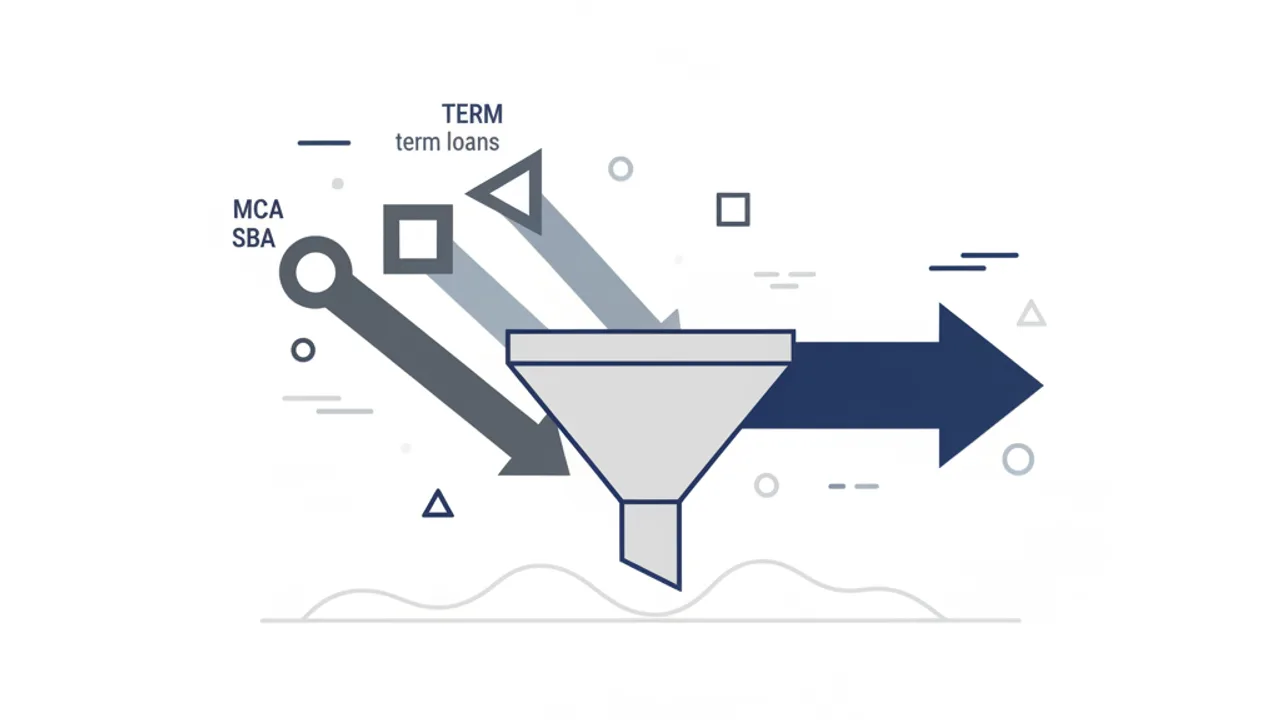
- True consolidation replaces MCA debt with lower-cost financing; reverse consolidation layers new MCA-like debt on top of existing obligations and almost always makes things worse.
- SBA 7(a) loans are the lowest-cost refinance option for qualified borrowers, with rates currently in the 10 to 13 percent range versus 50 to 200 percent effective APR on most MCAs.
- Traditional bank term loans require strong credit and 2 years of business history; they are not accessible to most businesses that are already in MCA distress.
- Reverse consolidation products are marketed as relief but are structurally just additional MCAs; they only make mathematical sense in very specific circumstances and are routinely misrepresented at the point of sale.
- The math on consolidation requires comparing total payoff cost under the current MCA structure versus the total cost of new financing, including fees, origination, and the time value of reduced daily payments.
MCA debt consolidation is the process of replacing one or more merchant cash advances with a different form of financing at a lower cost, longer term, or more manageable payment structure. It is one of the most discussed exits from MCA debt, but it is also one of the most misunderstood. True consolidation -- replacing MCA obligations with genuinely lower-cost debt -- is achievable for some businesses. But a large portion of what is marketed as "MCA consolidation" is actually reverse consolidation, which adds new debt rather than resolving existing obligations. This guide explains the difference and covers each real consolidation option in detail. For the full landscape of MCA exit options, see the MCA debt relief 2026 guide.
True Consolidation vs Reverse Consolidation: The Critical Distinction
This distinction is the most important thing to understand before you take a call from anyone offering to "consolidate" your MCA debt.
True consolidation means the new financing is used to pay off the existing MCA balances in full. The MCA is gone. You now owe a different creditor under different terms -- ideally a longer repayment period, a lower effective cost of capital, and payments that represent a sustainable percentage of revenue. After true consolidation, the UCC liens from the MCA funders should be terminated, COJs withdrawn, and ACH access revoked.
Reverse consolidation means a new funder (usually another MCA or MCA-adjacent product provider) gives you a lump sum, which you use to pay down your existing MCA balances partially, while simultaneously beginning payments to the new funder. You now have the same or more total debt, split between the old funders (if not fully paid off) and the new one. Daily payments from all sources combined are often higher than before. This is the most common form of "MCA consolidation" marketed to small businesses in distress, and it is almost always harmful to the borrower.
How to identify reverse consolidation at the pitch stage:
- The product is offered by a company that also originates MCAs
- The "consolidation" does not pay off the existing MCAs in full
- The new product charges a factor rate or has daily payments, not a fixed interest rate
- The new funder takes a first position UCC lien, adding to your existing lien stack
- You are still making payments to the original funders after the "consolidation"
If the answer to any of these is yes, you are being pitched a reverse consolidation, not a true consolidation. There are scenarios where reverse consolidation makes sense -- they are narrow and covered below -- but they require careful math.
SBA 7(a) Loan Refinance: The Lowest-Cost Option for Qualified Borrowers
An SBA 7(a) loan is the closest thing to a true MCA replacement for businesses that qualify. The SBA guarantees a portion of the loan, which allows participating lenders to offer rates and terms that are unavailable through conventional commercial lending to small businesses that lack collateral or track record.
Current rate range: SBA 7(a) variable rates are tied to the prime rate plus a lender spread. As of early 2026, effective rates for most borrowers are in the 10 to 13 percent range, sometimes lower for large, well-qualified businesses. Compare this to the effective APR on a typical MCA: a 1.4 factor rate on a 6-month advance works out to roughly 80 percent APR. A 7(a) loan at 12 percent APR used to pay off that advance saves substantial cost.
Eligibility requirements:
- 2 or more years in business (most lenders require 2 years minimum; SBA itself requires the business to be established and operating)
- Personal credit score generally above 650 (some lenders accept 620 with compensating factors)
- Adequate business cash flow to service the new loan
- Business must be for-profit and meet SBA size standards
- No recent bankruptcies or federal debt delinquencies
- The proceeds must be used for eligible purposes, which include refinancing existing business debt
MCA refinance eligibility: The SBA has issued guidance confirming that 7(a) proceeds can be used to refinance MCAs, but with conditions. The MCA being refinanced must not have been originated under terms that were fraudulent or violated applicable law. The refinancing must produce a clear economic benefit to the borrower (lower payments, longer term, lower cost). Some SBA lenders are reluctant to refinance MCAs because they view them as evidence of poor financial management, so lender selection matters.
The process: SBA loans are originated through participating SBA lenders (banks and credit unions with SBA authorization) and non-bank SBA lenders (CDFIs and specialty lenders). The application involves 2 years of business tax returns, 2 years of personal tax returns, business financial statements, a business plan if the loan is over $350,000, and details of the debt being refinanced. Underwriting takes 2 to 8 weeks at most lenders; SBA Express products can close faster.
For help navigating SBA options alongside other exit approaches, see how to choose an MCA debt relief company.
Traditional Bank Term Loan Consolidation: Credit and Time-in-Business Requirements
A conventional bank term loan used to pay off MCA debt is true consolidation. The bank advances a fixed principal amount, you use it to retire the MCA balances, and you repay the bank over a 3 to 7 year term at a fixed or variable interest rate.
The challenge is qualification. Banks that offer term loans to small businesses require:
- Personal credit score of 680 or above, preferably 720 or above
- Minimum 2 years in business with consistent revenue history
- Positive business bank account history (no significant overdrafts, no returned items)
- Sufficient cash flow to service the new debt at a debt service coverage ratio of at least 1.2 (meaning for every dollar of loan payment, you have at least $1.20 in available cash)
- Collateral, for most loans above $50,000 (real estate, equipment, or accounts receivable)
Businesses that are already in MCA distress often fail one or more of these criteria. Missed MCA payments may have damaged the business's relationship with its primary bank. Cash flow under multiple MCA holdbacks may not look sufficient for a term loan on paper even if the business would be healthy without the MCA payments.
Where term loan consolidation works: A business that took one or two MCAs during a temporary cash crunch, has otherwise strong financials, has not missed MCA payments, and is seeking to refinance before the situation deteriorates. This is a pre-distress consolidation play, and it is the cleanest path if you can qualify.
Credit union alternatives: Some credit unions have small business loan programs that are somewhat more flexible than bank term loans, particularly for businesses with an existing deposit relationship. Worth exploring if bank term loans are not accessible.
Reverse Consolidation Products: How They Work, Typical Costs, and Risks
Reverse consolidation is a product category, not a single product. The general mechanics: a new funder provides capital that is used to reduce (not necessarily eliminate) existing MCA balances, while the new funder begins collecting its own daily or weekly remittance. The pitch is that the new funder has lower daily payments spread over a longer term.
Typical reverse consolidation structure:
- New funder advances $80,000
- $60,000 is used to pay down (but not off) two existing MCAs
- Remaining $20,000 is provided as working capital
- New funder charges a 1.25 to 1.45 factor rate
- New funder begins daily ACH of $600 to $900
- Existing funders continue collecting on remaining balances
In the worst case, the business is now paying three funders instead of two, at a higher combined daily rate.
When reverse consolidation makes narrow sense:
- The existing MCAs are being paid at current terms and the daily rate from the new funder is demonstrably lower than the combined rate from the existing MCAs being retired
- The existing MCAs are fully paid off (not just reduced) with the new proceeds
- The new funder's factor rate and term produce a lower total cost-of-capital than the remaining weighted average cost on existing advances
- The business has a specific reason (large incoming receivable, seasonal cash flow event) that makes the short-term cost increase survivable
Run the full math: total cost of the reverse consolidation (principal times factor rate) versus total remaining cost on current MCAs, plus the value of reduced daily payments on cash flow. Only proceed if the numbers actually support it.
Risks to know:
- Reverse consolidation providers frequently misrepresent the total cost or structure the disclosure to obscure the effective rate
- Many reverse consolidation providers operate in states that now require commercial financing disclosures (see the 2026 settlement landscape for disclosure law details)
- Adding a new UCC-1 lien on top of existing liens may make conventional refinancing harder later
- If the business cannot service the new combined payment structure, you have made the situation significantly worse
Line of Credit Strategies
A business line of credit, if accessible, can serve as a true MCA replacement for businesses whose MCA use was driven by working capital timing gaps rather than fundamental cash flow insufficiency.
Revolving lines of credit from banks and credit unions: Require similar qualifications to term loans -- strong credit, 2 years in business, positive cash flow. A revolving line at prime plus 2 to 4 percent is dramatically lower cost than an MCA. Availability is limited for businesses in MCA distress.
Invoice factoring and invoice financing: If your business generates commercial invoices and the cash flow problem is a timing mismatch between invoicing and collection, invoice factoring or financing can provide working capital at a cost that is usually lower than MCA. Factor rates on commercial invoices typically range from 1 to 5 percent of the invoice value per 30-day period, depending on customer creditworthiness. The underlying credit of your customers is more important than your own credit in this model.
Revenue-based financing (true revenue-based): Distinct from MCAs despite similar nomenclature, true revenue-based financing from reputable lenders ties the repayment to a percentage of monthly revenue with a cap, so payments slow down when revenue slows and the total payback is defined as a multiple of principal. Some technology companies and CDFIs offer this. Look for lenders who are members of the Small Business Finance Association or who have signed the Responsible Business Lending Coalition's Small Business Borrowers' Bill of Rights.
Fintech lenders: Kabbage (now American Express Business Blueprint), OnDeck, Fundbox, and similar platforms offer lines of credit with underwriting that is faster and more flexible than banks. Rates are higher than bank lines but substantially lower than MCAs. These are viable consolidation instruments for businesses with decent credit that do not qualify for bank products.
Math: When Consolidation Actually Saves vs Just Delays
The single most important analysis before any consolidation move is comparing total repayment cost under each scenario. Daily payment relief is appealing, but if the new financing costs more in total, you have not improved your position -- you have just slowed the bleeding.
Total cost framework:
For each existing MCA, calculate: remaining purchased amount. That is the total you still owe.
For the proposed consolidation, calculate: total repayment amount under the new instrument. For an SBA 7(a) or bank term loan, that is principal plus total interest over the full repayment term. For a reverse consolidation, it is principal times factor rate.
The consolidation saves money if: sum of all remaining MCA purchased amounts is greater than the total repayment amount under the new instrument.
Example:
- MCA 1 remaining purchased amount: $45,000
- MCA 2 remaining purchased amount: $38,000
- Total MCA remaining cost: $83,000
- Proposed SBA 7(a) loan: $80,000 principal at 12% APR over 5 years = approximately $106,000 total repayment
In this example, the SBA loan saves $0 in total cost -- it actually costs $23,000 more. However, it spreads that repayment over 5 years instead of potentially 6 months, which dramatically reduces daily cash flow pressure and may be worth the additional total cost for a business that needs breathing room.
Daily payment comparison:
- Combined MCA daily holdback: $1,400/day
- SBA 7(a) monthly payment: $1,778/month ($59/day equivalent)
The daily payment drops by over 95 percent. Even though the total cost is higher, the business's ability to operate without constant cash flow stress is restored. This is the correct analysis framework: total cost matters, but so does daily cash flow viability. Both numbers need to appear in your decision.
For the full context of exit options beyond consolidation, including settlement and restructuring, read DIY settlement vs professional approaches and the MCA attorney complete guide.
Sources
- SBA 7(a) Loan Program Overview and Eligibility— U.S. Small Business Administration
- CFPB Small Business Lending Data and Commercial Finance— Consumer Financial Protection Bureau
- California DFPI Commercial Financing Disclosure Requirements— California Department of Financial Protection and Innovation
- Responsible Business Lending Coalition -- Small Business Borrowers' Bill of Rights— Responsible Business Lending Coalition
Your next step
If you're dealing with MCA debt, these are the three paths that actually work. Start with the cheapest option that fits your situation.
- DIY negotiationFree and the most common starting point. Use our negotiation playbook first.
- MCA debt relief companyPaid service that handles negotiation for you. See our side-by-side comparison. Our disclosure: we work with Coastal Debt Resolve, details on /how-we-make-money.
- MCA attorneyNeeded when lawsuits are filed or contracts are legally defective. See the attorney guide.